
This comprehensive guide explains everything you need to know about American Airline Lost Baggage, including how baggage tracing works, when luggage is considered lost, how compensation may apply, and practical steps you can take to protect yourself during future trips.
Losing your luggage can quickly turn an exciting trip into a stressful experience. Whether you’re traveling for business, a family vacation, or an international journey, discovering that your checked bag didn’t arrive can leave you wondering what to do next.
Fortunately, there are established procedures for reporting, tracking, and recovering missing baggage. Understanding the process can help reduce delays, improve communication with the airline, and increase the likelihood of recovering your belongings.
What You’ll Learn
In this guide you’ll discover:
- What qualifies as delayed versus lost baggage
- Immediate actions to take at the airport
- How baggage tracing works
- Documents you’ll need
- How compensation and reimbursement may work
- Domestic versus international baggage rules
- Common mistakes travelers should avoid
- Practical baggage protection tips
- Frequently asked questions
What Is Considered American Airline Lost Baggage?
Lost baggage refers to checked luggage that cannot be located after extensive tracing efforts. Initially, missing luggage is usually classified as delayed baggage, as many bags are reunited with their owners within a few days. If the airline cannot locate the baggage after continued searches, it may eventually be treated as lost, and compensation procedures may begin.
Although many travelers use the terms lost luggage and delayed baggage interchangeably, they are not the same.
Typically, airlines first classify missing bags as delayed because luggage may simply have missed a connection, been loaded onto another flight, or arrived at the wrong airport.
Common reasons baggage may be delayed include:
- Tight flight connections
- Weather disruptions
- Airport operational delays
- Security inspections
- Aircraft changes
- Tagging errors
- International customs procedures
In many cases, delayed baggage is recovered and delivered within a few days.
Delayed vs. Lost Baggage
| Delayed Baggage | Lost Baggage |
|---|---|
| Bag location is still being traced | Bag cannot be located after extensive search |
| Often recovered within days | Recovery becomes increasingly unlikely |
| Tracking updates remain active | Compensation procedures may begin |
| Delivery arranged once found | Claim settlement may apply if unrecovered |
Understanding this distinction helps set realistic expectations while the tracing process is underway.
Common Reasons Checked Luggage Goes Missing
Most baggage is not permanently lost. Instead, it becomes temporarily separated from its owner because of operational issues.
The most common causes include:
1. Missed Flight Connections
Short layovers leave little time for baggage transfers between aircraft.
2. Incorrect Baggage Tags
If a baggage tag becomes damaged or is attached incorrectly, routing systems may struggle to identify the correct destination.
3. Airport Congestion
Busy travel seasons increase baggage handling volumes, creating more opportunities for delays.
Examples include:
- Summer holidays
- Thanksgiving travel
- Christmas season
- Spring break
4. Weather Disruptions
Storms, hurricanes, heavy snowfall, and severe weather may force airlines to reroute both aircraft and baggage.
5. Flight Changes
Unexpected aircraft substitutions or schedule adjustments sometimes prevent luggage from making the same flight.
6. Security Screening
Occasionally, bags require additional inspection before continuing to their destination.
7. International Customs Procedures
International baggage sometimes experiences delays due to customs processing requirements or additional documentation checks.
Industry Insight
According to aviation industry reports, the vast majority of mishandled baggage is eventually reunited with its owner. Modern baggage tracking technologies, barcode systems, RFID implementations at some airports, and global baggage tracing networks have significantly improved recovery rates compared with previous decades.
What to Do Immediately If Your Baggage Is Missing
The first hour after discovering your luggage is missing is often the most important. Taking the right steps promptly can help speed up the tracing process and ensure your report contains accurate information.
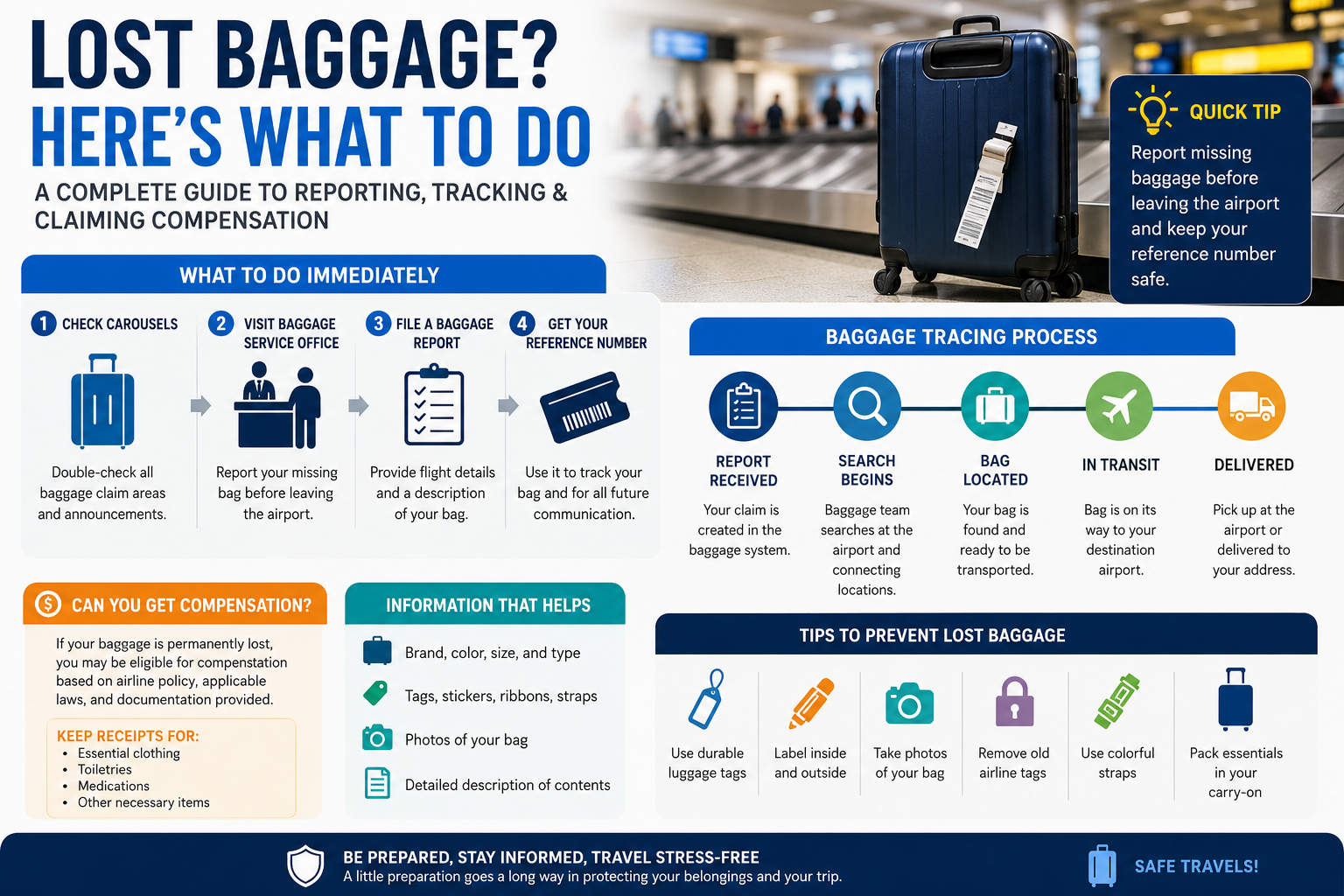
Step 1: Stay Inside the Baggage Claim Area
Before leaving the airport:
- Double-check every baggage carousel.
- Verify that your bag was not placed in an oversized baggage area.
- Look for airport announcements regarding delayed luggage.
- Confirm your baggage tag matches the correct flight.
Many bags are recovered within minutes after arriving on a different baggage belt.
Step 2: Visit the Baggage Service Office
If your luggage still cannot be found, proceed to the airline’s baggage service office before exiting the airport.
Be prepared to provide:
- Boarding pass
- Baggage claim receipt
- Government-issued identification
- Flight details
- Bag description (size, color, brand, identifying features)
The baggage representative will begin the tracing process and create a formal report for your missing luggage.
Step 3: Obtain a Baggage Report Reference Number
Once your report is filed, you will receive a reference number for your case. Keep this information in a safe place, as it is typically required for tracking updates, follow-up inquiries, reimbursement requests, or any future claim related to your baggage.
This reference number serves as the primary identifier for your baggage tracing case and should be included in all communications regarding your missing luggage.
How to Track American Airline Lost Baggage
After reporting your missing luggage, the next priority is tracking its progress. Most baggage is located within a few days, especially when the baggage report contains accurate details.
Step 1: Keep Your Baggage Reference Number
The baggage report reference number is the key to checking your case. Save it in multiple places, such as your phone, email, or travel documents.
Step 2: Monitor Status Updates
As baggage handlers receive new information, your case status may change. Typical updates include:
- Report received
- Bag located
- In transit
- Arrived at destination airport
- Scheduled for delivery
- Delivered
Checking updates regularly helps you stay informed without making unnecessary calls.
Step 3: Stay Available
If the baggage team contacts you, respond promptly. Delays in confirming your delivery address or phone number can slow the return of your luggage.
Step 4: Update Missing Information
If you remember additional identifying details, such as stickers, ribbons, luggage straps, or unique contents, provide that information. Even small details can help baggage agents distinguish your suitcase from similar bags.
How Long Does It Take to Recover Lost Baggage?
Quick Answer
Many delayed bags are reunited with passengers within 24 to 72 hours. International itineraries, weather disruptions, and multi-airport connections may extend recovery times. If baggage cannot be located after extensive tracing efforts, the airline may classify it as permanently lost and begin the compensation process.
Recovery times vary depending on several factors.
| Situation | Typical Recovery Time |
|---|---|
| Domestic direct flight | 1–2 days |
| Domestic connection | 1–3 days |
| International flight | 2–7 days |
| Severe weather disruption | Several days |
| Complex multi-airline itinerary | One week or longer |
These are general estimates. Actual recovery times depend on the specific circumstances of your trip.
What Information Helps Locate Your Bag Faster?
Providing detailed information improves the chances of quickly identifying your luggage.
Helpful details include:
- Brand name
- Color
- Size
- Hard-shell or soft-sided design
- Wheel type
- Handle color
- Identification tags
- Distinctive luggage straps
- Airline priority tags
- Stickers from previous trips
- Monograms or initials
Example
Instead of describing your bag as “a black suitcase,” say:
“Medium-sized black Samsonite hard-shell suitcase with four spinner wheels, blue luggage strap, white destination tag, and a red ribbon attached to the top handle.”
This level of detail makes it much easier for baggage agents to identify your luggage.
Can You Buy Essential Items While Waiting?
One of the most common questions travelers ask is whether they can purchase necessities while waiting for delayed baggage.
In many situations, passengers may be eligible to request reimbursement for reasonable emergency purchases, depending on the circumstances and applicable airline policies.
Examples of reasonable purchases include:
- Basic clothing
- Undergarments
- Toiletries
- Prescription medications (where appropriate)
- Chargers
- Personal hygiene products
Luxury shopping, designer clothing, expensive electronics, or non-essential purchases are generally less likely to qualify.
Expert Tip
Keep every receipt.
Without receipts, reimbursement requests may become much more difficult to process.
Create a digital backup by photographing each receipt immediately after purchase.
Documents You Should Keep
Good record-keeping makes the claims process smoother.
Maintain copies of:
- Boarding pass
- Checked baggage receipt
- Baggage report
- Reference number
- Flight itinerary
- Purchase receipts
- Hotel confirmation (if applicable)
- Delivery confirmation
- Email correspondence
- Photos of your luggage
Having these documents readily available can save time if additional information is requested.
Compensation for American Airline Lost Baggage
If checked baggage is determined to be permanently lost, passengers may be entitled to compensation, subject to applicable regulations, airline policies, and documentation supporting the value of the lost contents.
Compensation depends on several factors, including:
- Domestic or international travel
- Applicable laws
- Declared baggage value (if any)
- Documentation provided
- Actual value of the lost items
Factors That Affect Compensation
Compensation may vary based on:
- Original purchase price
- Item depreciation
- Available receipts
- Proof of ownership
- Maximum liability limits established under applicable regulations
Providing organized documentation usually leads to a smoother claims process.
Domestic vs. International American Airline Lost Baggage Rules
Different rules often apply depending on your itinerary.
| Domestic Flights | International Flights |
|---|---|
| Governed by U.S. regulations | Often governed by the Montreal Convention |
| Compensation limits may differ | International liability rules apply |
| Domestic reporting procedures | International documentation requirements |
| U.S.-based baggage handling | Cross-border baggage tracing may be required |
Understanding which rules apply helps travelers know what documentation and timelines may be involved.
Common Reasons Compensation May Be Delayed
Compensation requests sometimes take longer than expected because of incomplete information.
Common issues include:
- Missing receipts
- Incomplete baggage descriptions
- Incorrect contact details
- Missing baggage tag
- Late submission
- Missing proof of ownership
- Duplicate claims
- Inconsistent information
Review your paperwork carefully before submitting any claim.
Tips to Increase the Chances of Recovering Your Luggage
Experienced travelers often take preventive measures before every trip.
Consider these best practices:
- Attach a durable luggage tag.
- Place your contact information inside the suitcase.
- Photograph your luggage before departure.
- Photograph the contents.
- Remove outdated airline tags.
- Use brightly colored luggage straps.
- Avoid checking valuables.
- Keep medications in your carry-on.
- Carry one change of clothes in your cabin bag.
- Arrive early to check baggage.
These simple habits can significantly improve baggage identification and reduce travel stress.
Items You Should Never Pack in Checked Baggage
Certain belongings are safer when carried onboard.
Avoid checking:
- Passports
- Cash
- Credit cards
- Jewelry
- Laptops
- Tablets
- Cameras
- Prescription medications
- Important documents
- Business contracts
- Irreplaceable keepsakes
Keeping these items with you minimizes inconvenience if your checked luggage is delayed.
Common Mistakes Travelers Make
Many baggage issues become more difficult because passengers unintentionally make avoidable mistakes.
The most common errors include:
- Leaving the airport without reporting the missing bag
- Throwing away the baggage receipt
- Waiting several days before filing a report
- Forgetting to save receipts for emergency purchases
- Packing valuables in checked luggage
- Providing only a vague bag description
- Ignoring follow-up communications
- Not updating delivery information after changing hotels
Avoiding these mistakes can improve both recovery time and the overall claims experience.
Expert Recommendations for Stress-Free Travel
Frequent travelers and aviation professionals recommend preparing for baggage disruptions before your trip begins.
Follow these practical recommendations:
- Label every suitcase clearly inside and outside.
- Take recent photos of your luggage and its contents.
- Keep expensive items in your carry-on.
- Purchase travel insurance if carrying valuable belongings.
- Arrive early enough to avoid rushed baggage check-in.
- Save digital copies of all travel documents.
- Keep baggage claim tags until your trip is complete.
- Pack essential items in your cabin bag in case checked luggage is delayed.
Planning ahead won’t prevent every baggage issue, but it can make the recovery process much easier and reduce the impact of unexpected travel disruptions.
Understanding the Difference Between Delayed, Lost, and Damaged Baggage
Travelers often confuse these three terms, but they refer to different situations.
| Type | Meaning | Typical Outcome |
|---|---|---|
| Delayed Baggage | Bag arrives later than the passenger | Usually recovered and delivered |
| Lost Baggage | Bag cannot be located after extensive tracing | Compensation process may begin |
| Damaged Baggage | Bag arrives with physical damage | Repair, replacement, or compensation may be available |
Knowing the distinction helps you understand which reporting process and documentation may apply to your situation.
Frequently Asked Questions (FAQ)
1. What should I do immediately if my baggage is missing?
Stay inside the baggage claim area, check all baggage carousels, and visit the airline’s baggage service office before leaving the airport. Report the missing luggage as soon as possible and keep your baggage reference number for future tracking.
2. How long does it usually take to recover delayed baggage?
Many delayed bags are recovered within 24 to 72 hours. However, international flights, severe weather, or complex flight connections can extend the recovery time.
3. When is baggage officially considered lost?
Missing baggage is generally treated as delayed while tracing efforts continue. If the luggage cannot be located after an extended search, it may eventually be classified as permanently lost according to applicable regulations and airline procedures.
4. Can I track my missing luggage?
Yes. After filing a baggage report, you’ll receive a baggage reference number that allows you to monitor updates as your luggage moves through the tracing process.
5. Can I purchase necessities while waiting?
Passengers may be eligible to request reimbursement for reasonable essential purchases made while waiting for delayed baggage. Keeping original receipts is important for any reimbursement request.
6. What documents should I keep?
Keep copies of:
- Boarding pass
- Baggage claim receipt
- Baggage report
- Reference number
- Flight itinerary
- Purchase receipts
- Photos of your luggage
- Email correspondence
These documents help support baggage tracing and compensation requests.
7. Does travel insurance cover lost baggage?
Many travel insurance policies provide baggage coverage, but benefits vary by insurer and policy. Review your policy to understand coverage limits, exclusions, and claim requirements.
8. What information helps identify my luggage?
Provide as much detail as possible, including:
- Brand
- Color
- Size
- Hard-shell or soft-sided design
- Luggage tag
- Stickers
- Ribbons
- Straps
- Unique markings
- Contents
Detailed descriptions help baggage teams identify your suitcase more quickly.
9. Should I throw away my baggage claim tag?
No. Keep your baggage claim receipt until your luggage has been returned and your trip is complete. It serves as important proof that your baggage was checked.
10. What items should never be packed in checked baggage?
Always keep valuable or essential items in your carry-on, including:
- Passports
- Cash
- Electronics
- Prescription medication
- Jewelry
- Important documents
- Keys
- Business materials
11. Can I recover compensation if my baggage is never found?
If baggage is determined to be permanently lost, compensation may be available based on applicable regulations, airline policies, and the documentation you provide regarding the contents and value of your luggage.
12. Does international travel have different baggage rules?
Yes. International baggage claims may be governed by international agreements such as the Montreal Convention, which establishes rules regarding airline liability for delayed, damaged, or lost baggage.
13. How can I reduce the chances of losing my baggage?
You can lower the risk by:
- Using durable luggage tags
- Removing old airline stickers
- Taking photos of your suitcase
- Labeling the inside of your luggage
- Packing essentials in your carry-on
- Arriving early for check-in
- Using distinctive luggage straps or tags
14. What happens after my baggage is located?
Once your baggage is found, it is typically transported to your destination airport. Depending on the circumstances, it may be made available for pickup or delivered to the address you provided during the baggage reporting process.
15. Is delayed baggage the same as lost baggage?
No. Delayed baggage is still being traced and is often recovered, while lost baggage refers to luggage that cannot be located after extensive search efforts and may qualify for compensation under applicable rules.