

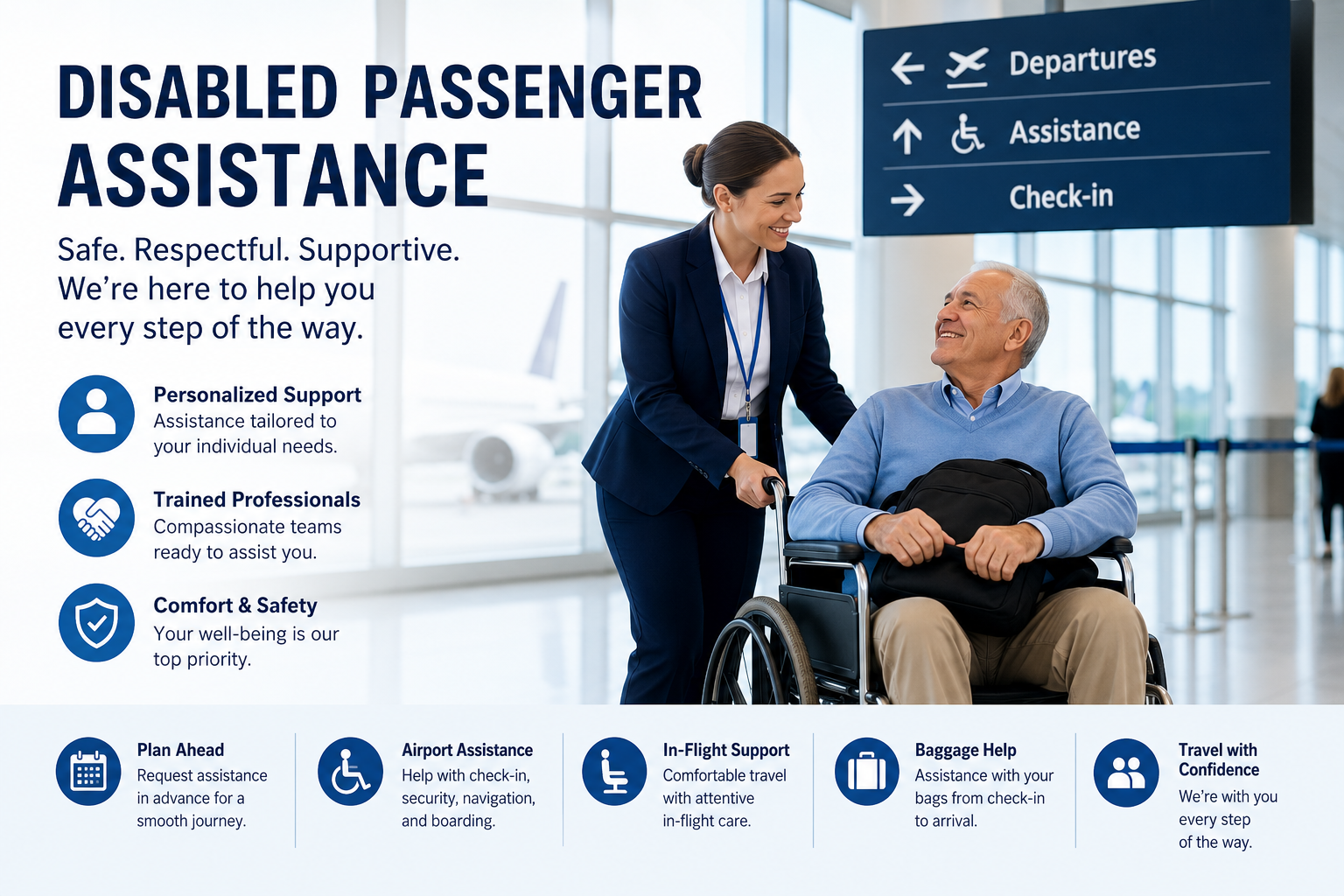
Flying with a disability can be much easier when the right support is arranged before you reach the airport. American Airlines disabled passenger assistance can cover wheelchair service, mobility support, hearing and vision assistance, cognitive or developmental support, accessible seating, service animals and certain medical devices. American Airlines currently lets customers request special assistance while booking or by managing an existing trip.
The key is to understand exactly what support you need and communicate it early.
What You’ll Learn
This guide explains:
- How to request American Airlines disability assistance
- Wheelchair and mobility assistance
- Assistance for hearing and vision disabilities
- Cognitive and developmental support
- Pre-boarding and accessible seating
- Service-animal requirements
- Medical and mobility devices
- What assistance is available during connections
- What to do if assistance fails
- Your rights under U.S. disability-travel rules
- A practical pre-flight checklist
- Frequently asked questions
What Is American Airlines Disabled Passenger Assistance?
American Airlines disabled passenger assistance is the range of accessibility services available to customers whose disability affects mobility, hearing, vision, cognition, development or other aspects of air travel. Depending on the traveller’s needs, assistance can include airport wheelchair service, help reaching gates, boarding and deplaning assistance, accessible seating, communication support and arrangements for assistive devices.
American Airlines says customers can request special assistance when booking or later through the airline’s trip-management tools. A Special Assistance Coordinator may contact the customer before the journey to make sure arrangements are ready.
Who may need special assistance?
Support can be useful for travellers who:
- Use a wheelchair, scooter, walker or cane
- Have difficulty walking long distances
- Need assistance boarding or leaving an aircraft
- Are blind or have low vision
- Are deaf or hard of hearing
- Have a cognitive or developmental disability
- Travel with a service dog
- Need to bring a medical or assistive device
- Need accessible seating or additional space
A disability does not automatically mean you need every type of assistance. Request only the support that matches your actual needs.
How to Request American Airlines Disability Assistance
The simplest approach is to add the request before travel.
Step-by-step process
1. Add assistance during booking.
On the passenger-details page, look for “Add special assistance.” American Airlines lists wheelchair assistance, mobility or medical devices, hearing, vision, cognitive or developmental assistance and service-animal arrangements among the available options.
2. Add assistance after booking.
If your ticket has already been purchased, find your trip using your confirmation code or Advantage account. Then go to the Special Services area and select Special Assistance.
3. Describe the actual support required.
For example, explain whether you need wheelchair transportation to the gate, help between connecting gates, assistance boarding or support because of a vision impairment.
4. Contact Special Assistance for complicated needs.
Some situations require more planning, especially medical devices, battery-powered mobility equipment or service animals.
5. Confirm the request before departure.
Keep your confirmation details and arrive early enough to identify yourself to airline staff.
American Airlines currently lists 800-237-7976 for Special Assistance and 800-735-2988 for hearing or speech-impaired assistance. The airline also lists a disability team at 800-892-3624 for special-assistance problems after travel. Verify contact details before publishing or travelling because airline contact information can change.
American Airlines Wheelchair Assistance
Wheelchair assistance is one of the most common accessibility requests.
American Airlines says wheelchair assistance can be requested for:
- Travel to and from your gate
- Movement between gates during connections
- Transportation to baggage claim
- Airport mobility support
You can request it in advance, but American also says customers can notify a team member at the airport on the day of travel.
What should you do at the airport?
- Tell an American Airlines representative that wheelchair assistance has been requested.
- Confirm whether you need help to the gate.
- If you have a connection, confirm assistance is needed between gates.
- At your destination, confirm you need assistance to baggage claim or the terminal exit.
- If you use your own wheelchair, make sure staff know whether it is manual, powered, collapsible or non-collapsible.
The U.S. DOT says airlines must provide prompt airport assistance when requested by a passenger with a disability. This can include ground wheelchairs, accessible carts, boarding wheelchairs, onboard wheelchairs and assistance between gates.
Important: airport wheelchair vs. your own wheelchair
These are different services.
An airport wheelchair helps you move through the airport. Your personal wheelchair or scooter is your mobility equipment and may be transported separately.
American Airlines recommends labelling mobility equipment with your contact details and recording the make, model, serial number and normal wear before travelling.
Travelling With a Wheelchair or Mobility Device
American Airlines accepts various mobility and medical devices. Some smaller assistive devices may be carried in the cabin without counting toward the standard carry-on limit. Larger wheelchairs and scooters may need to be checked depending on their size and the aircraft’s cargo-door dimensions.
Before travelling with a powered wheelchair
Prepare:
- Wheelchair dimensions
- Weight
- Battery type
- Make and model
- Serial number
- Disassembly instructions
- Removable components
- A small repair or device toolkit, if appropriate
American Airlines advises passengers to check their aircraft and cargo-door limitations in advance if their wheelchair is large. Battery restrictions also apply.
A useful expert tip is to photograph the chair from several angles before handing it over. This creates a simple record of its condition and accessories.
What if the wheelchair is damaged?
Report damage as soon as possible, preferably before leaving the airport.
American Airlines currently states that delayed mobility devices should be reported within 24 hours for domestic itineraries or 21 days for international itineraries. For damage, its current page lists 24 hours for domestic itineraries and 7 days for international itineraries. The airline also says it may provide temporary replacement equipment and repair or replace a device in qualifying circumstances.
Assistance for Blind, Deaf and Hard-of-Hearing Passengers
Disability assistance is not limited to wheelchair users.
Vision assistance
American Airlines says customers who are blind or have low vision can inform a ticket agent if they need help checking in or reaching their gate. Assistance can include a courtesy wheelchair, arm assistance or directions. The airline also recommends informing staff even when airport assistance is not required so safety briefings and important flight updates can be provided appropriately.
Hearing assistance
Passengers who are deaf or hard of hearing can tell a gate agent or flight attendant about their needs. American Airlines states that open captioning is available for safety videos and recommends notifying staff so passengers receive safety briefings and important flight updates.
Practical tip: Do not rely only on the mobile app for critical travel information. Ask the gate agent how boarding announcements and schedule changes will be communicated.
Cognitive and Developmental Disability Assistance
American Airlines also provides support for customers with cognitive or developmental disabilities, including help with boarding, deplaning and connections.
However, there is an important distinction between assistance and continuous personal care.
American Airlines says a safety assistant may be required when a traveller cannot independently follow safety instructions, manage certain personal needs, wait alone for an escort or manage certain disruption-related situations.
Before booking, consider whether the passenger can:
- Follow crew safety instructions
- Understand evacuation instructions
- Manage personal food, hygiene or medical needs
- Wait safely for an escort
- Handle unexpected delays
If continuous personal support is necessary, arrange an appropriate travel companion rather than assuming airline staff can provide one-to-one care throughout the journey.
Pre-Boarding and Accessible Seating
Passengers who need additional time or assistance can request early boarding at the gate. American Airlines also provides seating arrangements for various accessibility needs, including passengers who cannot move over a fixed armrest, use a service animal, have an immobilised leg or need additional space.
If you need more than one seat
American Airlines says customers who need more than one seat for safe and comfortable travel should call Reservations when booking. The airline states that it can arrange two adjacent seats at the same fare in qualifying circumstances.
Do not wait until boarding if you already know that standard seating will not meet your needs.
Service Animals and Disabled Passengers
American Airlines permits fully trained service dogs in the cabin at no charge when they meet applicable requirements. Its current policy distinguishes service animals from emotional-support, comfort and service animals in training.
For flights operated by American, the airline recommends submitting the U.S. DOT Service Animal Air Transportation Form at least 48 hours before departure. Flights longer than eight hours may require an additional relief attestation.
Key service-dog reminders
- Submit required forms early.
- Keep copies with you.
- Keep the dog harnessed, leashed or tethered as required.
- Check destination-specific animal-entry rules.
- Do not assume an emotional-support animal has the same status as a service animal.
For international travel, government entry rules can be separate from airline requirements. The CDC currently requires a CDC Dog Import Form receipt for dogs entering or returning to the United States, with additional rules depending on the dog’s travel and vaccination history.
Medical Devices and Portable Oxygen Concentrators
American Airlines also provides arrangements for certain medical and assistive devices.
Examples include:
- CPAP equipment
- Mobility devices
- Medical devices
- Portable oxygen concentrators
- Battery-powered equipment
American Airlines says many assistive devices do not count toward the normal carry-on limit when they meet the relevant conditions.
Portable oxygen concentrators
If you use a POC, check the airline’s current approved-device requirements before travelling.
American Airlines currently requires passengers using a POC to check in at the gate so an agent can verify the equipment, explain when it can be used and check that enough battery power is available. The airline specifies batteries sufficient for at least 150% of the flight and ground connection time, including possible delays.
This is one reason medical-device travellers should avoid leaving arrangements until the day of departure.
What Are Disabled Passengers Legally Entitled To?
For flights covered by U.S. law, the Air Carrier Access Act (ACAA) prohibits discrimination against passengers with disabilities. DOT’s rules are contained in 14 CFR Part 382. The rules apply to U.S. airline flights and certain international flights to or from the United States.
The DOT Disability Bill of Rights identifies rights including:
- Dignity and respect
- Accessible information
- Accessible airport facilities
- Airport assistance
- Aircraft assistance
- Assistive devices and service animals
- Seating accommodations
- Accessible aircraft features
- Resolution of disability-related issues
Why this matters for American Airlines passengers
In October 2024, DOT announced a $50 million penalty against American Airlines after finding serious disability-related violations involving wheelchair assistance and wheelchair handling during 2019–2023. DOT described the penalty as 25 times larger than any previous DOT airline penalty for disability-regulation violations.
The figure is important context, but travellers should not assume it describes today’s service in every airport. Policies, training and systems can change. In December 2025, DOT modified the payment structure of the penalty and directed American to spend $16.1 million on equipment and systems intended to improve wheelchair handling, while crediting $700,000 for compensation already provided to affected passengers.
The practical lesson is simple: know your rights, but also document your needs clearly and report problems promptly.
What If American Airlines Assistance Does Not Arrive?
If the requested assistance is missing or delayed:
- Ask an American Airlines employee for immediate help.
- Clearly state what assistance you requested.
- Ask the agent to document the problem.
- If you are at a connection point, explain the impact on your next flight.
- If your mobility device is damaged, photograph it immediately.
- Report the problem before leaving the airport whenever possible.
- Keep boarding passes, baggage tags, photos and written communications.
- Contact American Airlines’ disability team if the issue is not resolved.
DOT says passengers with disabilities have a right to prompt and timely assistance, and airlines have obligations concerning trained personnel and accessible equipment.
American Airlines currently lists a 24/7 disability team number for special-assistance issues after travel.
TSA Assistance Is Separate From Airline Assistance
A common mistake is assuming that airline assistance automatically covers airport security screening.
TSA handles security screening. TSA’s TSA Cares programme provides information and support for travellers with disabilities and medical conditions, including the option of requesting a Passenger Support Specialist.
A smart travel plan therefore separates three stages:
American Airlines: booking, airline accessibility, boarding, deplaning and mobility support.
Airport: terminal facilities and certain airport accessibility services.
TSA: security screening.
Understanding that distinction can prevent confusion on travel day.
American Airlines Disabled Passenger Assistance Checklist
Use this checklist before leaving home:
- Special assistance request added to reservation
- Wheelchair or mobility-device details provided
- Battery information checked
- Accessible seating confirmed
- Medical-device requirements checked
- Service-animal forms completed, if applicable
- Destination entry rules checked
- Medication and medical equipment packed
- Mobility device photographed
- Important phone numbers saved
- Connection assistance requested
- Arrival assistance requested
- Extra travel time planned
- Assistance needs explained to airport staff
Frequently Asked Questions
1. Does American Airlines provide assistance for disabled passengers?
Yes. American Airlines offers several types of special assistance, including wheelchair service, mobility assistance, hearing and vision assistance, cognitive and developmental support, accessible seating and assistance involving service animals and medical devices.
2. How do I request disability assistance on American Airlines?
During booking, select Add special assistance on the passenger-details page. For an existing reservation, find your trip and use the Special Services section to add Special Assistance.
3. Does American Airlines offer wheelchair assistance?
Yes. Wheelchair assistance can cover travel to and from the gate, movement between connecting gates and transportation to baggage claim.
4. Is American Airlines wheelchair assistance free?
Airport wheelchair assistance is generally provided as an accessibility service rather than a standard paid optional service. Personal mobility devices are also subject to separate transportation rules. Always confirm current requirements for your specific itinerary.
5. Can disabled passengers board early on American Airlines?
Yes. American Airlines says customers requiring special assistance can request early boarding at the gate.
6. Can I bring my wheelchair on American Airlines?
Yes, subject to aircraft, size, battery and safety requirements. Some collapsible devices can be carried in the cabin, while larger or non-collapsible equipment may need to be checked.
7. Does American Airlines assist disabled passengers during connections?
Yes. American Airlines lists assistance between gates for connecting flights as part of its wheelchair assistance service.
8. Does American Airlines help blind or low-vision passengers?
Yes. Customers can request help reaching the gate, including directions, arm assistance or a courtesy wheelchair when needed.
9. Does American Airlines help deaf or hard-of-hearing passengers?
Yes. Passengers can notify gate agents or flight attendants about hearing needs. American Airlines also states that open captioning is available for safety videos.
10. Can a disabled passenger travel alone?
Many passengers with disabilities can travel independently. However, American Airlines says a safety assistant may be required in certain circumstances where a passenger cannot perform essential safety or personal-care functions independently.
11. What happens if American Airlines damages my wheelchair?
Report the damage promptly, preferably before leaving the airport. American Airlines currently provides specific reporting windows for domestic and international itineraries and states that qualifying damaged or lost mobility devices may receive repair, replacement or temporary equipment.
12. Do service dogs need advance notice?
American Airlines recommends submitting the DOT Service Animal Air Transportation Form at least 48 hours before the flight. Certain longer journeys may require an additional relief attestation.
13. Can I travel with a portable oxygen concentrators?
Potentially, yes. American Airlines has requirements for approved POCs, gate verification and sufficient battery power. The current policy states that batteries should cover at least 150% of flight and connection time.
14. What law protects disabled airline passengers?
The Air Carrier Access Act protects passengers with disabilities from discrimination in covered air travel. Its implementing regulations are found in 14 CFR Part 382.
15. What should I do if disability assistance is not provided?
Ask an airline employee for immediate assistance, document what happened, report damaged mobility equipment promptly and retain supporting records. If the problem remains unresolved, use American Airlines’ disability complaint channels and consider the appropriate DOT complaint process.






2 responses to “Could One Simple Step Improve Your American Airlines Assistance Experience?”
[…] Airlines mobile check-in is the process of checking in for an eligible flight through the American Airlines app on a smartphone or […]
[…] Who Can Benefit from Avelo Airlines Wheelchair Assistance? […]