
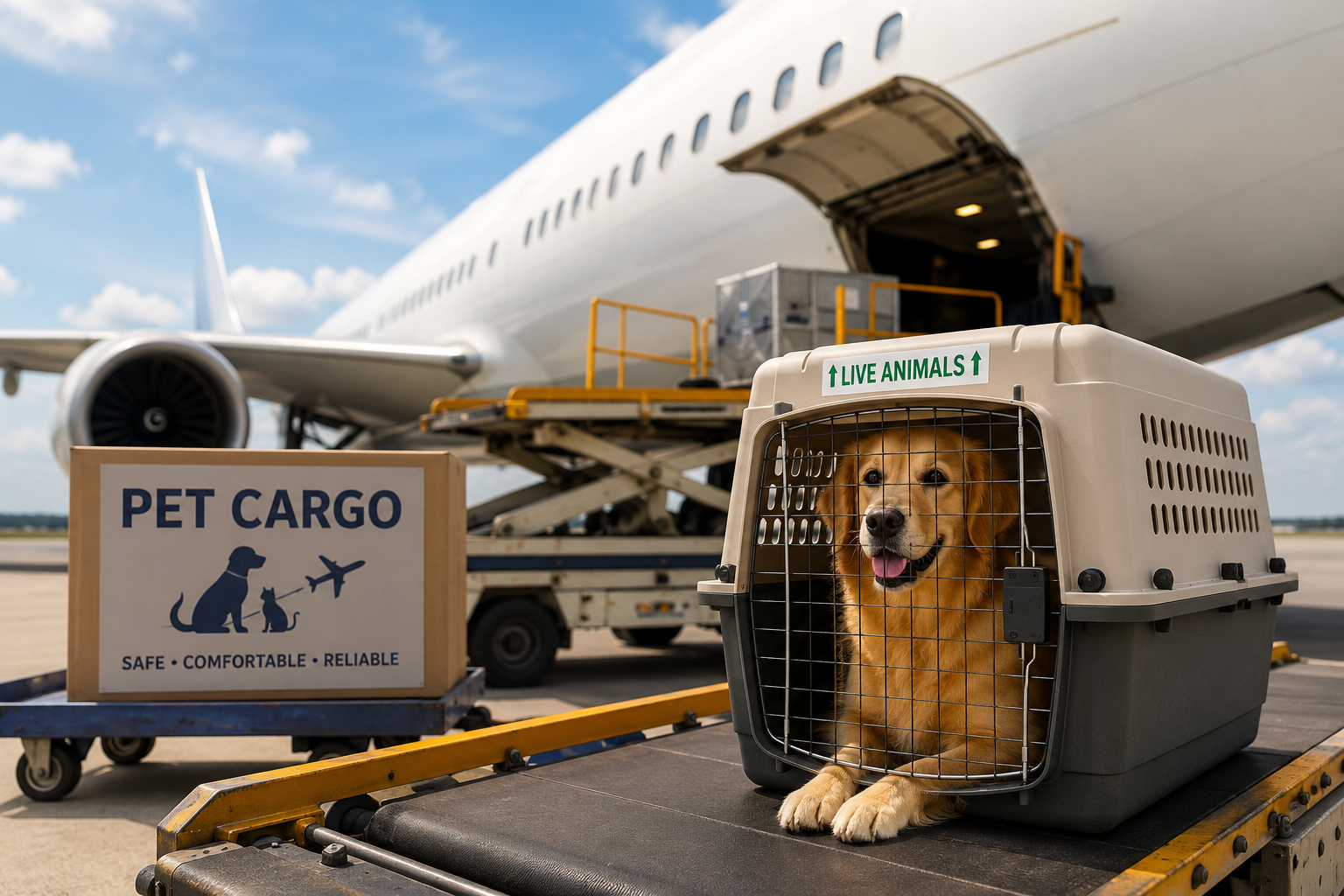
Moving with a large dog, a cat that cannot fit safely under an aircraft seat, or another eligible animal can make air travel feel complicated. American Airlines pet cargo is handled through American Airlines Cargo’s PetEmbark programme, which is designed for pets that do not qualify for ordinary cabin travel or certain checked-pet options.
The key is preparation. Your pet must meet age, breed, health, kennel, aircraft, route and temperature requirements before American accepts the shipment. American says its PetEmbark programme has more than 65 years of experience transporting animals and uses climate-controlled areas and dedicated animal-handling procedures.
What Is American Airlines Pet Cargo?
American Airlines pet cargo is a dedicated live-animal transportation service operated through American Airlines Cargo’s PetEmbark programme. It is intended for eligible pets and animals that need to travel through the airline’s cargo system rather than as an ordinary cabin pet. Depending on the shipment, pets may travel under Priority Parcel Service (PPS) or ExpediteFS.
This does not mean your pet is simply treated like an ordinary suitcase.
American states that dogs and cats travelling through PetEmbark are kept in climate-controlled areas while waiting and travel in a pressurised, climate-controlled aircraft compartment. The pet is generally loaded last and unloaded first.
American Airlines Pet Cargo at a Glance
| Requirement | Current guidance |
|---|---|
| Programme | American PetEmbark |
| Domestic pet age | Generally at least 8 weeks |
| International dog age | At least 6 months |
| PPS eligibility | Domestic, under 100 lb combined pet + kennel, qualifying kennel |
| Temperature | 45°F–85°F normally |
| 20°F–44°F | Vet-signed acclimation letter required |
| Below 20°F | Not accepted |
| Above 85°F | Not accepted |
| Booking window | Up to 10 days before travel |
| Recommended booking lead time | At least 24 hours |
| Tracking | Air waybill number |
| Additional handling fee | $150 per air waybill |
American’s current policy states that an additional $150 handling fee per air waybill applies to animal rates.
Who Can Use American Airlines Pet Cargo?
PetEmbark is useful when a pet cannot travel as a standard carry-on pet or when the shipment requires the airline’s cargo service.
For domestic travel, American generally accepts most animals from eight weeks of age, subject to the applicable restrictions. Dogs travelling internationally must be at least six months old.
Before booking, check these points:
- Your pet’s species is accepted.
- Your pet is old enough.
- The breed is not restricted.
- Your pet appears fit to travel.
- The kennel is compliant.
- The aircraft can carry the kennel.
- Weather conditions are within the permitted range.
- Your origin and destination accept the type of animal.
- Required veterinary and government paperwork is complete.
American also states that it may refuse an animal displaying aggressive behaviour or one that does not appear fit to travel.
What Pets Can Travel as Cargo?
American’s cargo system can handle various animals, but rules differ by species and route. Household pets commonly considered for PetEmbark include dogs and cats, while certain other animals may also be accepted subject to specific requirements.
Do not assume that because an animal is accepted on one route it is accepted on every route.
How Much Does American Airlines Pet Cargo Cost?
There is no single flat American Airlines pet cargo price.
American says the cost depends on factors such as the pet’s size and whether the journey is domestic or international. Smaller domestic pets may travel through Priority Parcel Service, while larger pets and international shipments generally use ExpediteFS.
An additional $150 handling fee per air waybill applies to animal rates.
PPS vs ExpediteFS
| Feature | Priority Parcel Service (PPS) | ExpediteFS |
|---|---|---|
| Typical use | Smaller domestic pets | Larger or international shipments |
| Weight rule | Under 100 lb combined for PetEmbark eligibility | Used when PPS limits are exceeded |
| International use | Generally not the standard option | Yes |
| Rate | Calculated according to shipment | Based on published/routing rates |
| Handling fee | $150 per air waybill | $150 per air waybill |
For PPS, American states that domestic pets within the continental U.S., Puerto Rico or into Hawaii can qualify when the combined pet-and-kennel weight is under 100 lb and the kennel is no larger than 36 × 26 × 28 inches. International travel, travel out of Hawaii, or shipments exceeding those restrictions generally move to ExpediteFS.
Expert tip: Do not budget using a random price quoted on a blog or forum. Cargo rates can vary by routing, animal size, kennel dimensions and service. Use American’s current rate calculator or obtain the rate during the booking process.
American Airlines Pet Cargo Kennel Requirements
The kennel is one of the most important parts of the shipment.
Your pet must have enough room to stand, turn around, sit and lie down naturally. The kennel must also meet construction, ventilation and security requirements.
Key kennel rules
- Adequate ventilation is required.
- Domestic kennels need ventilation on three sides.
- International kennels need ventilation on four sides.
- Dog ventilation openings may be up to 1 × 1 inch.
- Cat ventilation openings may be up to ¾ × ¾ inch.
- The kennel door must be metal.
- Doors cannot be located on top.
- Snap closures must be reinforced with approved metal hardware.
- Wheels must be removed or made inoperable.
- Absorbent bedding should be used.
- Hay, straw and wood shavings are not permitted.
- Two accessible food and water dishes must be attached inside.
- Toys are not permitted during the journey.
Two puppies or two kittens can share a kennel when each is under 20 lb and under six months old, provided they are comparable in size and temperament and can move freely. Pets over six months generally travel one per kennel.
American Airlines Pet Cargo Temperature Restrictions
Temperature is a major factor in whether a shipment can travel.
American’s normal temperature range for warm-blooded animals is 45°F to 85°F at the relevant origin, connection and destination locations. The airline will not transport warm-blooded animals when temperatures exceed 85°F or fall below 20°F.
When temperatures are between 20°F and 44°F, a licensed veterinarian must provide an acclimation letter stating the exact lowest temperature the animal can tolerate.
American also maintains seasonal embargoes for certain hot cities. Its current summer guidance lists Phoenix, Las Vegas, Palm Springs and Tucson from May 1 through September 30.
Why temperature checks matter
The temperature at your departure airport may be acceptable while the connection airport is too hot.
For example, a pet flying from a cool northern city through a very hot hub could be refused even if the departure location feels comfortable.
Always check every airport on the itinerary.
American Airlines Pet Cargo Breed Restrictions
American does not accept several brachycephalic or snub-nosed dog and cat breeds because of respiratory risks.
Restricted dog breeds include examples such as:
- Bulldog breeds
- Boxer
- Pug
- Shih Tzu
- Pekingese
- Chow Chow
- Cane Corso
- Mastiff breeds
- Pit Bull
- Boston Terrier
- American Bully
Restricted cats include:
- Burmese
- Exotic Shorthair
- Himalayan
- Persian
The full current list should be checked before booking because breed and mixed-breed identification can affect acceptance. American requires a breed verification form for cats and dogs.
What Documents Does American Airlines Pet Cargo Require?
Documentation varies by route, animal and destination.
For many dog and cat shipments, prepare:
- Health certificate
- Rabies vaccination certification
- Breed verification form
- Required American Airlines acknowledgement documents
- Temperature acclimation letter when applicable
- International shipper documentation where required
- Destination-country import permits or certificates when required
American says the health certificate should contain information including breed, weight, age/date of birth and confirmation that the animal was examined and found free of relevant infectious or contagious disease. The examination and certificate must generally be dated within 10 days of arrival at the destination.
For international travel, requirements become more complex because the destination government controls entry rules. USDA APHIS advises travellers to work with a USDA-accredited veterinarian and check the current requirements for the destination country.
Important 2026 U.S. Dog Import Rule
Dogs entering the United States must meet current CDC requirements.
For dogs that have only been in dog-rabies-free or low-risk countries during the previous six months, a CDC Dog Import Form receipt is required. Dogs must also appear healthy, be at least six months old and have a detectable microchip.
Dogs that have been in high-risk countries can require additional documentation, depending on where they were vaccinated and their travel history.
This is one reason international pet cargo should be planned well ahead of the flight.
How to Book American Airlines Pet Cargo
American’s current PetEmbark process allows booking up to 10 days before departure, with at least 24 hours recommended. If your shipment is within 72 hours, American directs customers to its Animal Desk.
Step-by-step booking process
1. Confirm eligibility.
Check species, age, breed, route, aircraft, kennel and temperature.
2. Choose the correct kennel.
Measure your pet and confirm the kennel meets American’s requirements.
3. Determine the service.
Find out whether your shipment will travel as PPS or ExpediteFS.
4. Prepare documents.
Complete veterinary, breed and government paperwork before drop-off.
5. Submit the booking request.
Use American PetEmbark’s booking process or contact the Animal Desk when required.
6. Confirm drop-off instructions.
Location and minimum acceptance times vary by airport.
7. Prepare the pet for travel.
Provide food and water within the required pre-drop-off period and prepare the kennel.
8. Track the shipment.
American provides an air waybill number that can be used to monitor the journey.
What Happens at the Airport?
American recommends arriving early because the pet must go through acceptance and inspection procedures.
For general planning, American recommends at least two hours before domestic flights and four hours before international flights, although the exact minimum varies by location and service.
Bring:
- Two forms of identification
- Health certificate
- Rabies documentation
- Breed verification
- Required forms
- Acclimation letter if applicable
- Properly prepared kennel
- Food bag
- Feeding and watering instructions
American requires food and water to have been offered within four hours before the animal is delivered to the airline.
Can You Track American Airlines Pet Cargo?
Yes.
American provides an air waybill number for the animal shipment. This number can be used to track the pet’s status online. Customers can also sign up for notifications.
If the pet misses a connection or cannot travel because of circumstances within American’s control, the airline says it can rebook the pet. Depending on the situation, food, water, comfort stops, overnight kennelling or veterinary support may be provided.
What If the Pet’s Flight Is Delayed or Cancelled?
Pet cargo has additional operational considerations that ordinary passenger baggage does not.
American says that if an aircraft change makes the pet’s new routing unsuitable, the airline will contact the customer and provide a new routing option. Temperature problems can also trigger a rebooking.
For longer journeys, comfort stops may be required. American says dogs require a comfort stop in situations such as a first flight segment of seven hours or more with a connection, a same-day connection of seven hours or more, no same-day connection, or an itinerary longer than 24 hours.
The USDA also requires minimum care standards during air transport, including regular observation and food and water provisions. Dogs and cats aged 16 weeks or older must be offered food at least every 24 hours, while younger puppies and kittens must be offered food at least every 12 hours; potable water must be offered at least every 12 hours.
Can You Sedate a Pet for American Airlines Cargo?
No for household dogs and cats.
American says it will not knowingly accept household dogs or cats that have been sedated or tranquilised. The policy is based on the increased respiratory and cardiovascular risks associated with sedation at altitude.
Instead:
- Get your pet used to the kennel well before travel.
- Leave the kennel open at home.
- Use familiar bedding where permitted.
- Speak with your veterinarian about anxiety management.
- Never administer a sedative simply to make the journey easier without veterinary advice.
Is American Airlines Pet Cargo Safe?
No airline can promise that air travel carries zero risk. The sensible question is whether the carrier has procedures designed to manage those risks.
American describes climate-controlled animal holding areas, pressurised aircraft compartments, temperature monitoring, trained handlers, tracking and emergency veterinary support.
Government data also gives useful context. The U.S. Department of Transportation reported 161,335 animals transported by airlines in 2024, with 13 reported incidents involving death or injury and no lost animals, equivalent to 0.81 incidents per 10,000 animals transported.
That statistic covers the reporting system for airlines generally, not American Airlines PetEmbark specifically. It should therefore not be presented as an American Airlines safety rate.
Common American Airlines Pet Cargo Mistakes
Avoid these mistakes before travel:
- Booking without checking aircraft compatibility
- Assuming every American flight accepts animals
- Using an undersized or non-compliant kennel
- Ignoring connecting-airport temperatures
- Booking a restricted breed
- Forgetting the breed verification form
- Assuming a health certificate is valid indefinitely
- Using old international entry requirements
- Giving your dog or cat a sedative
- Arriving late at the cargo or airport drop-off point
- Forgetting food and water instructions
- Assuming cargo fees are a fixed flat rate
- Failing to check destination-country requirements
American Airlines Pet Cargo Pre-Flight Checklist
Use this checklist before the travel date:
- Pet meets minimum age requirements
- Breed has been verified
- Route is eligible
- Aircraft is compatible
- Weather is acceptable at all relevant stations
- Correct kennel is ready
- Health certificate is current
- Rabies documents are ready
- Breed verification is completed
- International paperwork is complete if required
- CDC requirements have been checked for U.S. entry
- Booking is confirmed
- Air waybill information is available
- Food and water have been offered within the required window
- Food bag is attached to the kennel
- Identification documents are ready
- Drop-off and collection locations are confirmed
FAQs About American Airlines Pet Cargo
1. Can I send my pet on American Airlines Cargo without flying with them?
Yes. PetEmbark is designed to transport eligible animals as cargo, so the pet does not necessarily have to travel with the owner. However, booking, documentation, route and destination requirements still apply.
2. Can puppies and kittens travel through American Airlines PetEmbark?
Yes, eligible puppies and kittens can travel through PetEmbark once they meet the applicable minimum-age requirements. Additional rules may apply depending on whether the journey is domestic or international.
3. Can two pets share the same cargo kennel?
In certain situations, two puppies or kittens may share a kennel. American Airlines generally requires them to be under six months old, each under 20 pounds, similar in size and temperament, and able to move comfortably inside the kennel.
4. Are pets allowed on every American Airlines flight?
No. Pet cargo availability depends on the aircraft, route, destination, weather conditions and other operational restrictions. Always confirm that your specific itinerary can accept your pet before making arrangements.
5. Can I use any crate for American Airlines pet cargo?
No. The kennel must meet American Airlines’ construction, ventilation, security and size requirements. An unsuitable kennel can result in the animal being refused for transportation.
6. Can I put my pet’s favourite toy inside the cargo kennel?
American Airlines’ current PetEmbark kennel guidance does not permit toys inside the kennel during transportation. Use appropriate absorbent bedding instead and follow the airline’s current kennel instructions.
7. Does my pet need food during a cargo flight?
Yes. Food and water arrangements are part of the PetEmbark preparation process. American requires food and water to be offered within the specified period before the animal is handed over, and longer journeys can require additional care.
8. Can I put food inside my pet’s kennel?
Food and watering arrangements must follow American Airlines’ current kennel and handling requirements. A food bag should be supplied with the shipment, and the required food and water containers must be securely attached to the kennel.
9. What happens if temperatures become unsafe after booking?
American Airlines may change or delay the pet’s routing when weather conditions make transportation unsuitable. This can happen even when the original itinerary was acceptable at the time of booking.
10. Does American Airlines provide overnight care for pets?
When operational circumstances require it, American Airlines says pets may receive appropriate care such as food, water, comfort stops or overnight kennelling. The exact arrangements depend on the situation and shipment.
11. Can service animals use PetEmbark cargo?
Service animals generally have different travel arrangements from household pets. If an animal is a trained service dog travelling with its passenger, check American Airlines’ current service-animal requirements rather than automatically booking PetEmbark.
12. Do I need a pet shipper for international American Airlines Cargo travel?
International animal shipments can involve additional procedures and documentation. Depending on the origin, destination and shipment type, a professional pet shipper or freight forwarder may be required.
13. Can American Airlines refuse my pet at the cargo terminal?
Yes. Acceptance is not guaranteed if the pet does not meet the applicable health, breed, kennel, documentation, temperature, aircraft or route requirements. Your pet can also be refused if it appears unfit for travel.
14. How should I prepare my pet for cargo travel?
Start kennel training well before the flight. Let your pet spend increasing amounts of time inside the kennel, use familiar routines, avoid last-minute changes and speak with your veterinarian about any health or anxiety concerns.
15. What should I do immediately after my pet arrives?
Collect the pet as soon as instructed, inspect its condition, provide water and allow it to rest in a quiet environment. If you notice unusual symptoms or signs of distress, contact a veterinarian promptly.