
Flying with a medical condition, disability, mobility limitation, or essential medical equipment can feel stressful. The good news is that American Airlines medical assistance covers several types of support, including wheelchair services, airport assistance, pre-boarding, mobility-device handling, and arrangements for certain medical devices.
American Airlines lets passengers request special assistance during booking or later through the airline’s trip-management tools. Its Special Assistance team can also help with medical and accessibility-related travel needs.
However, medical assistance does not mean that the airline provides personal medical treatment or replaces a doctor or medical escort. Passengers with complex medical needs should plan their care, equipment, medication and documentation before travelling.
What You’ll Learn
- What American Airlines medical assistance includes
- How to request special assistance
- Wheelchair and mobility-device options
- Rules for CPAP machines and portable oxygen concentrators
- Medical certificate requirements
- Medication and TSA screening tips
- What to expect at the airport
- What to do if assistance or equipment fails
- Your rights under U.S. disability regulations
- A practical pre-flight checklist
What Is American Airlines Medical Assistance?
American Airlines medical assistance refers to accessibility and travel support available to passengers who have disabilities, mobility limitations, or medical-device needs. It can include airport wheelchair assistance, pre-boarding, help during connections, handling of mobility equipment, and arrangements for approved medical devices.
The service is primarily designed to make air travel accessible and safe. It should not be confused with an onboard medical service or emergency treatment.
Under the Air Carrier Access Act, airlines generally cannot discriminate against qualified passengers because of disability. The U.S. Department of Transportation says passengers with disabilities have rights to assistance at airports, assistance on aircraft, accessible seating and transportation of assistive devices.
American Airlines medical assistance may include:
- Wheelchair assistance
- Airport mobility assistance
- Boarding and deplaning assistance
- Connection assistance
- Pre-boarding
- Assistance with certain mobility devices
- Medical-device transportation
- Portable oxygen concentrator arrangements
- Accessibility-related seating support
- Service-animal arrangements
- Assistance for hearing, vision, cognitive or developmental disabilities
The exact assistance depends on the passenger’s needs and the aircraft or itinerary.
How Do You Request Medical Assistance on American Airlines?
American Airlines recommends requesting special assistance when booking whenever possible. If your flight is already booked, you can find your reservation and select the Special Assistance option.
Step-by-step process
- Book or retrieve your American Airlines reservation.
- Select Add Special Assistance during booking or use the Special Services section after booking.
- Choose the assistance you require.
- Provide information about your wheelchair, mobility device or medical equipment when requested.
- Contact Special Assistance for complicated medical or equipment requirements.
- Confirm the request before travelling.
- Arrive early and tell the airport team that assistance has been requested.
American Airlines currently lists 800-237-7976 for Special Assistance and 800-735-2988 for hearing or speech-impaired assistance. The airline also lists 800-892-3624 for its Disability Team when passengers have experienced a previous special-assistance problem. Verify contact details before travel because airline contact information can change.
Do You Need 48 Hours’ Notice for American Airlines Medical Assistance?
Not for every type of assistance.
This is one of the most important distinctions passengers should understand. U.S. DOT rules generally prohibit airlines from requiring advance notice simply because a passenger has a disability. However, airlines may require up to 48 hours’ notice for certain services that need additional preparation.
For example, 48-hour notice can apply to using a passenger’s ventilator, respirator, CPAP machine or portable oxygen concentrator. It can also apply to certain stretcher arrangements, electric wheelchair transportation on aircraft with fewer than 60 seats, and other specialised accommodations.
Best practice
Even when advance notice is not legally required, request assistance as early as possible.
Early planning gives American Airlines time to coordinate:
- Wheelchair assistance
- Connecting-airport support
- Medical equipment
- Battery requirements
- Accessible seating
- Service-animal documentation
- Special handling instructions
If a passenger misses a notice deadline for a service where notice is permitted, the airline must still provide the accommodation when it can reasonably do so without delaying the flight.
American Airlines Wheelchair Assistance
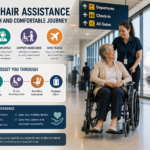
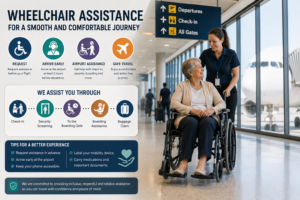
Wheelchair assistance can be especially useful for passengers who cannot comfortably walk long airport distances, need help reaching a gate, or require assistance boarding and leaving the aircraft.
American Airlines currently recommends submitting wheelchair details in advance and having the wheelchair’s dimensions and weight ready.
Passengers travelling with their own wheelchair should also record:
- Make and model
- Serial number
- Weight and dimensions
- Battery type
- Removable parts
- Disassembly instructions
- Existing damage
American advises passengers to label their equipment with their name and contact information and to arrive at the departure gate about one hour before scheduled departure when travelling with mobility equipment.
What onboard wheelchair assistance can cover
Flight attendants can assist with transfers between a passenger’s seat and an onboard wheelchair and can move the onboard wheelchair to and from the lavatory door. They cannot lift a passenger into or out of the wheelchair or bathroom. A traveller who needs that physical lifting assistance should travel with someone able to provide it.
Can You Bring a Wheelchair or Mobility Device?
Yes, subject to aircraft, battery and storage requirements.
American Airlines says mobility and medical devices generally do not count toward the standard carry-on limit. Depending on size and cabin space, some devices can be stored in the cabin while larger or non-collapsible devices may need to be checked.
For battery-powered mobility equipment, contact American Airlines in advance so the battery type and handling requirements can be confirmed.
Expert recommendation
Take photographs of the device before handing it over to the airline. Photograph:
- Wheels
- Handles
- Controls
- Seat
- Footrests
- Battery area
- Existing scratches or damage
This creates a useful record if the equipment arrives damaged.
What If American Airlines Damages or Delays Your Wheelchair?
This is an important area where preparation matters.
American Airlines currently instructs passengers to report damage at the airport when possible. Its published rules specify different reporting windows for domestic and international travel. For domestic itineraries, delayed or damaged mobility devices generally must be reported within 24 hours; international itineraries have longer periods for certain claims.
If a mobility or medical device is delayed, American says it will provide a temporary replacement and arrange prompt repair where appropriate. If the device is damaged beyond repair or lost, American states that it will replace it with the same or a comparable model.
What to do immediately
- Inspect the device before leaving the airport.
- Photograph any new damage.
- Report the problem to the Baggage Service Office.
- Keep your baggage report number.
- Retain receipts for related expenses.
- Follow American’s claim process within the applicable deadline.
Can You Bring Medical Equipment on American Airlines?
American Airlines allows various medical and assistive devices, but individual equipment can have specific requirements.
Examples include:
- CPAP machines
- Portable oxygen concentrators
- Respirators
- Ventilators
- Wheelchairs
- Mobility scooters
- Canes
- Walkers
- Other assistive devices
American states that CPAP machines and certain other medical devices can qualify as carry-on medical equipment and do not count toward the normal carry-on allowance.
Do not assume that every medical device automatically meets airline requirements. Check the equipment type, battery and storage rules before departure.
American Airlines Portable Oxygen Concentrator Rules
Passengers who need supplemental oxygen should plan particularly carefully.
American Airlines says passengers can use approved portable oxygen concentrators, or POCs, during flight when the applicable requirements are met. The airline does not accept personal compressed or liquid oxygen systems for use or transport in the same way as approved POCs because of hazardous-material restrictions.
Before boarding with a POC, American says an agent can:
- Confirm the POC is approved.
- Check that you can operate the equipment.
- Check that you can respond to its alarm.
- Explain when the POC can be used.
- Check your battery supply.
American currently requires enough fully charged batteries to power the POC for at least 150% of the total flight and ground connection time, including unexpected delays.
Important POC seating restrictions
A POC must fit beneath the seat in front of the passenger during taxi, takeoff and landing. Passengers using a POC cannot sit in an emergency exit, bulkhead or a seat that blocks another passenger’s aisle access.
The FAA also requires POCs to meet applicable acceptance criteria, and federal regulations prohibit POC use in exit seats.
Does American Airlines Require a Medical Certificate?
Not automatically.
Under 14 CFR §382.23, an airline generally cannot require a passenger with a disability to provide a medical certificate simply as a condition of travel. Limited exceptions include passengers travelling in a stretcher or incubator, passengers who need medical oxygen during a flight, or situations where there is reasonable doubt that the passenger can safely complete the flight without extraordinary medical assistance.
A medical certificate, when permitted under the regulation, is a statement from the passenger’s physician confirming that the passenger can safely complete the flight without extraordinary medical assistance. The federal rule says such a certificate must generally be dated within 10 days of the scheduled initial departure.
Do not assume you need a doctor’s note
A common mistake is obtaining medical paperwork simply because a passenger has a chronic condition or disability.
Instead:
- Identify the accommodation you need.
- Check American Airlines’ current requirements.
- Contact Special Assistance if your situation is complex.
- Ask your doctor about fitness to fly when medically appropriate.
- Obtain documentation if the airline or applicable rules specifically require it.
Can You Bring Medication on American Airlines?
Passengers should keep essential medication accessible throughout the journey.
For flights involving U.S. security screening, TSA says medications in pill, liquid and solid forms are permitted but are subject to screening. Medically necessary liquids can exceed the standard 3.4-ounce/100 mL limit in reasonable quantities for the trip and should be declared for separate screening.
Practical medication checklist
Keep important medication in your carry-on rather than relying on checked baggage.
Pack:
- Prescription medication
- Necessary over-the-counter medication
- Prescription information
- Doctor or pharmacy contact details
- Required syringes or medical supplies
- Cooling equipment for temperature-sensitive medication
- Backup supplies where medically appropriate
TSA also advises passengers with diabetes to tell officers about medical devices and supplies before screening.
For international travel, check the medication laws of the destination and transit countries as well. A medicine that is legal in one country can be restricted in another.
What Should You Expect at the Airport?
A smooth trip usually depends on communicating your needs more than once.
At check-in
Tell the agent that you have a special-assistance request. If you have a wheelchair or medical device, confirm that it is correctly noted.
At security
TSA screening still applies. Tell the officer about medically necessary liquids, medical devices or equipment that require special handling.
At the gate
Confirm your assistance with the gate agent. If you have a POC, American says to check in at the gate so the agent can verify the device and battery supply.
During boarding
Passengers requiring assistance may qualify for pre-boarding. American’s customer service information also describes airport and boarding assistance for passengers with special needs.
During a connection
Do not assume assistance automatically transfers perfectly between airlines. If part of your journey is operated by another carrier or is a codeshare flight, American advises passengers to contact the operating carrier about its rules for medical and mobility devices.
What Are Your Rights as a Passenger With a Disability?
The Air Carrier Access Act protects eligible passengers with disabilities from discrimination in air travel. DOT says the law applies to flights operated by U.S. airlines and to flights to or from the United States by foreign airlines.
Passengers have rights involving:
- Dignified treatment
- Airport assistance
- Assistance on aircraft
- Accessible seating
- Assistive devices
- Service animals
- Accessible information
- Complaint resolution
The DOT’s Airline Passengers with Disabilities Bill of Rights summarises these protections.
Why this matters for American Airlines passengers
In October 2024, DOT announced a $50 million penalty against American Airlines after finding numerous disability-related violations between 2019 and 2023, including inadequate wheelchair assistance and mishandling of wheelchairs and scooters.
The situation has continued to evolve. In December 2025, DOT modified the financial terms and required American to spend $16.1 million on additional accessibility improvements, including wheelchair movers, 119 wheelchair lifts at Miami, Philadelphia and Chicago O’Hare, and an assistive-device tracking system.
American says it transported more than 208,000 wheelchairs and other personal mobility devices in 2024 and invested more than $175 million that year in services, infrastructure, training and technology related to specialised equipment and accessibility.
These figures show why medical and disability assistance is not simply a minor customer-service feature. Accessibility involves airport operations, equipment handling, training and passenger rights.
Common Mistakes to Avoid
1. Waiting until the airport
Even when advance notice isn’t mandatory, waiting can make complicated arrangements harder.
2. Assuming every medical condition requires a doctor’s letter
Federal rules do not allow airlines to routinely require medical certificates for passengers with disabilities.
3. Forgetting battery requirements
Medical devices and powered wheelchairs can have specific battery restrictions.
4. Checking essential medication
Keep essential medication accessible during travel.
5. Relying on aircraft power
American recommends carrying fully charged batteries for necessary medical equipment rather than depending on an available power outlet.
6. Ignoring partner-airline rules
A codeshare itinerary can involve another operating carrier with different device procedures.
7. Leaving the airport before inspecting your wheelchair
Check for damage and report it promptly.
American Airlines Medical Assistance: Quick Checklist
Before travelling, confirm:
- Special assistance has been added to your reservation.
- Your wheelchair or mobility device details are recorded.
- Battery type has been checked.
- Medical equipment meets airline requirements.
- POC approval has been confirmed if applicable.
- You have enough POC battery capacity.
- Medication is in your carry-on.
- Medical liquids are ready for TSA screening.
- Required documentation is available.
- Operating carriers have been checked for codeshare flights.
- You know where to report damaged equipment.
- You have allowed extra airport time.
Frequently Asked Question
1. Can I request medical assistance on American Airlines?
Yes. American Airlines allows passengers to request special assistance during booking or after booking through its trip-management tools. Assistance can include wheelchair service, mobility-device support and other accessibility arrangements.
2. How do I request American Airlines medical assistance?
During booking, select Add Special Assistance. If you have already booked, retrieve your trip and use the Special Services/Special Assistance option. Complex medical-device requirements should be confirmed with American’s Special Assistance team.
3. Does American Airlines provide wheelchair assistance?
Yes. American provides wheelchair and airport assistance for passengers who need mobility support. Passengers travelling with their own wheelchair should provide dimensions, weight and other equipment information when arranging assistance.
4. Do I need to request medical assistance 48 hours before my flight?
Not for every accommodation. Federal rules generally do not permit airlines to require advance notice for disability assistance, but up to 48 hours’ notice can apply to specific services such as using a POC, CPAP, respirator or ventilator.
5. Does American Airlines require a doctor’s note?
Not automatically. Under federal rules, medical certificates can only be required in specific circumstances, such as certain stretcher/incubator travel, medical oxygen or when there is reasonable doubt about a passenger’s ability to safely complete the flight without extraordinary medical assistance.
6. Can I take a CPAP machine on American Airlines?
American Airlines lists CPAP machines among medical/assistive devices that can qualify for special handling and generally do not count toward the standard carry-on allowance, subject to applicable storage and safety requirements.
7. Can I bring a portable oxygen concentrator on American Airlines?
Yes, approved portable oxygen concentrators can be transported and used when the airline’s requirements are met. American requires passengers to check in at the gate and have sufficient battery power, including a 150% battery supply based on flight and ground connection time.
8. Does American Airlines provide medical oxygen?
Passengers should not assume that American provides therapeutic oxygen onboard. American’s current guidance focuses on passenger-supplied approved POCs. Federal rules distinguish carrier-supplied medical oxygen from passenger use of a POC.
9. Can I bring prescription medication through airport security?
Yes. TSA permits medication in pill, liquid and other forms, subject to screening. Medically necessary liquids can exceed 100 mL/3.4 oz in reasonable quantities and must be declared for screening.
10. What happens if American Airlines damages my wheelchair?
Report the damage as soon as possible, ideally before leaving the airport. American’s current guidance provides specific reporting windows for domestic and international itineraries and describes repair or replacement procedures.
11. Can I receive assistance during a connecting flight?
Yes, airport and connection assistance may be available. If another airline operates part of your itinerary, confirm its rules because American advises passengers to check the operating carrier’s requirements for medical and mobility devices.
12. Can passengers with temporary disabilities request assistance?
Potentially, yes. DOT’s definition of disability can include certain temporary impairments that substantially limit a major life activity.